
Why pure 3D digital twins are probably a bad idea
Ricardo Mayerhofer – 01/21/2026
If you’re in the middle of a large factory, there’s only so much you can observe. You can only look in one direction, you can’t see behind machines and irrelevant details draw your attention.
When creating a digital representation of a factory that mimics the real world, we face the same issues, bringing real-world limitations to the digital world.
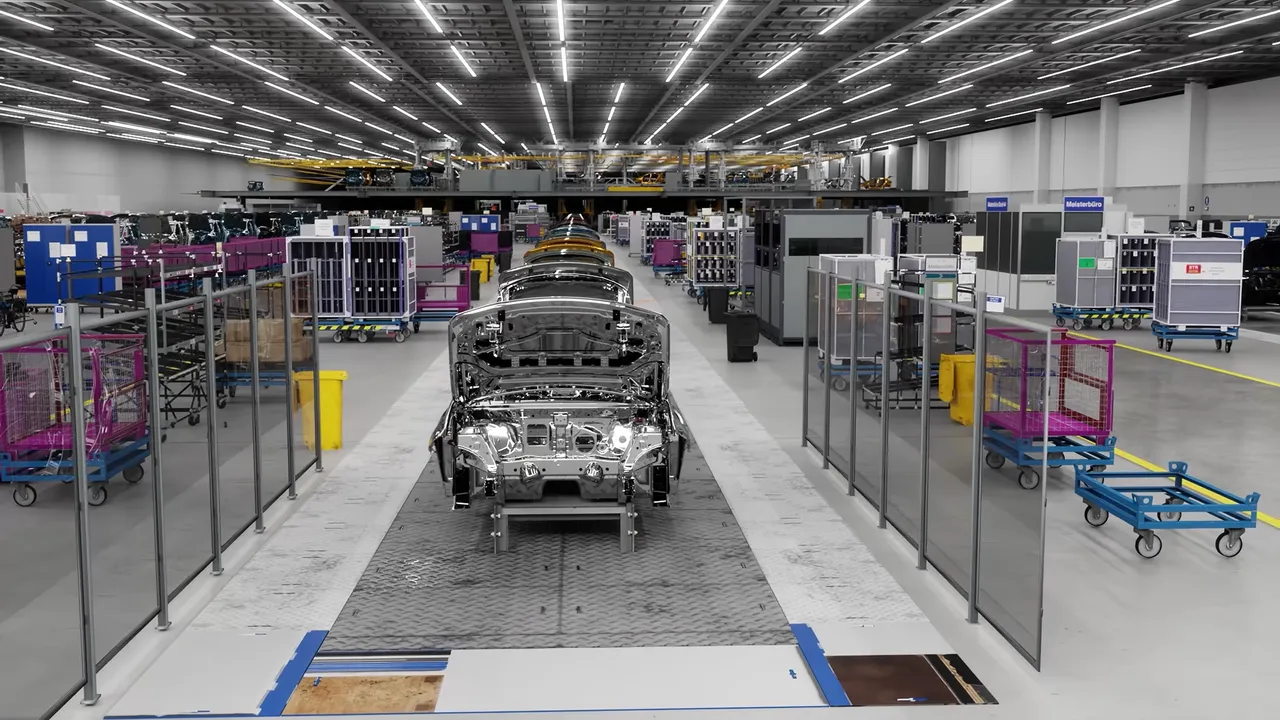
The 3D digital twin of a car plant
Over the years, many techniques have been developed in technology to overcome these limitations, enabling seeing, understanding and interacting with information at scale. This involves mixing elements of reality with abstractions that only exist in the virtual world. Below, we explain and demonstrate some of these techniques.
Google Maps and details-on-demand
A great example of how to understand and navigate reality at scale is Google Maps. In a simple and intuitive interface, it enables users to navigate billions of addresses, millions of roads and have context around them. It helps users effectively drive to locations and find places that matter to them.
An example of details-on-demand in Google Maps
The fundamental concept behind Google Maps is details-on-demand. At a higher level view we can only see countries and their borders, zoom in further and you can see states, then cities, roads and businesses. Then, if you need, you can see a full 3D view of a specific location, which is helpful for example, if you’re close to the location trying to figure out where exactly it is.
The pattern is powerful, but simple, create a simpler abstraction of the actual thing and let the user request details for areas of interest. We can apply the same pattern to a digital twin.
In the example below, we have a large industrial complex with 10 buildings. First we have an abstraction of the entire complex, showing the status of each building. Then when requesting more details of a specific building, we can see the production lines, the status of each machine and the 3D of a machine.
An example of details-on-demand in a factory
Augmented reality and digital content
Another helpful technique is to mix elements that represent reality with pure digital content (e.g. elements that only exist in the virtual world). We can see a similar technique in augmented reality, where the mix of reality and digital content helps users understand their surroundings.
In digital twins we can leverage a wide range of digital elements. We demonstrate some of these in the example below:
- A circle with the production line number and a text right below it showing its performance
- A polygon showing the extension of a production line and its status
- A balloon on top of the machines with its performance
- A polygon around the machines showing its status
- An animated line indicating the flow of materials and their direction.
All these elements combined create a much richer and comprehensible representation of reality.
Computing power
Another challenge of building pure 3D digital twins is the required computing power and download speed. For the digital twin to effectively help a team on their daily activities, it should be accesible on the field using limited resources devices such as mobile phones and tablets connected on mobile networks.
Even using techniques such as LOD it’s impractical to render large detailed 3D environments on mobile devices. Some solutions resort to rendering the environment on the cloud and streaming the result to the device, but this often results in poor user experience due to the lag between the user input and the system response.
Conclusion
Like in Google Maps, 3D can be extremely useful to accomplish specific tasks but is suboptimal when used alone to represent large operations. The combination of lower fidelity abstractions, details-on-demand and digital elements creates effective digital twins that scale to today’s needs.